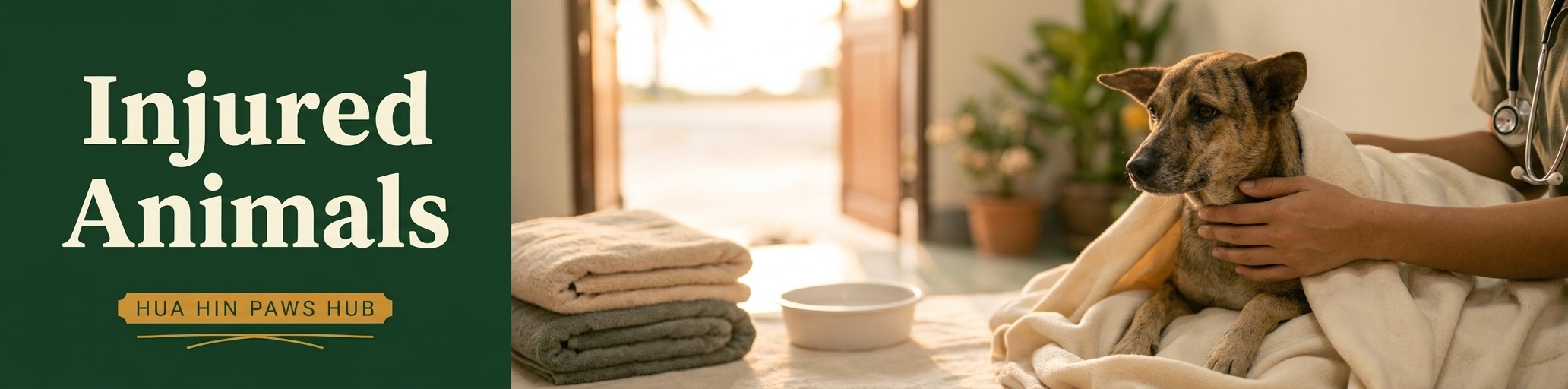
Found an injured animal?
🆘 If no community group can help
Community groups are often full, and some animals have nowhere to go. If you have found an injured animal and no group can take it, you may need to fund the initial treatment yourself and ask the community to help cover the cost. The steps below are the most reliable way to do that.
- Get the animal to a vet immediately. Treatment cannot wait — everything else on this list comes after this.
- Ask the vet for a full medical report. A written report of the injuries found and the treatment required. Donors will rely on this to know the case is real.
- Collect all the evidence. An itemised bill, copies of any X-rays or scans, and photos — of the animal injured, during treatment, and once it is recovering.
- Post to the community groups asking for support. Share the report, photos and cost breakdown on the local animal welfare groups. You may be surprised how many people will help. Update as you go, and once the costs have been recovered, close the post with a short note confirming this so donors know their money was used as promised.
- Return the animal once it has recovered. To where you found it if it is a stray, or to its owner if it is someone's pet.
Your safety comes first
An animal in pain can bite or scratch even if it has never done so before — including your own pet, and including dogs that look calm. You cannot help an animal if you are injured too.
- Never put your bare hands near the mouth or head of an injured animal you don't know.
- Check the traffic before you step onto the road. More rescuers are hurt by cars than by animals.
- Use a barrier — a towel, a board, a box, or a piece of cardboard — rather than direct contact.
- Keep children, other dogs and bystanders back before you approach.
- If the animal is a stray and behaving aggressively, do not attempt to handle it. Call a vet or rescue service and keep it in sight from a safe distance.
🚑 What to do, step by step
Work through these in order. If the animal is in immediate danger from traffic, skip to step 2 and call for help before doing anything else.
- Assess from a distance Is the animal breathing? Is it conscious? Is it bleeding heavily? Is it trapped? Note the species and approximate size. Look for an owner, a collar, or a nearby house before you assume it is a stray.
- Call for help before you move it Phone a vet clinic and describe the situation — they can talk you through what to do and tell you whether to bring the animal in or wait for assistance. See the emergency contacts below.
- Approach calmly and contain it Speak softly, move slowly, and stay out of biting range. Drop a towel or blanket over the animal's head to reduce panic, then lift it using the towel as a sling. For a small animal, a cardboard box with air holes works well. For a larger dog, a blanket used as a stretcher needs two people — one at the shoulders, one at the hips.
- Control bleeding and keep it warm Press firmly on a bleeding wound with a clean cloth or gauze for at least five minutes without lifting to check. Keep the animal warm with a blanket — injured animals lose body heat quickly, and shock is often more dangerous than the visible wound.
- Transport carefully to the vet Keep the animal as still as possible. Don't let it loose in the car — a frightened animal can climb into the footwell or out of a window. Have someone sit with it if you can. Drive steadily; sudden braking is painful for an injured animal.
- Tell the vet everything you know What happened, when it happened, whether the animal has eaten, whether it has been vaccinated, and whether it is a stray. If you are paying for treatment, say so up front — some clinics will treat strays at reduced cost, but only if they know.
✕ What not to do
- Don't give food or water. An injured animal may choke, vomit, or need surgery — and anaesthetic is dangerous on a full stomach.
- Don't give human painkillers. Paracetamol and ibuprofen are highly toxic to dogs and cats. A small dose can be fatal.
- Don't pull out an embedded object. A stick, glass or metal fragment may be plugging the wound. Pad around it and let the vet remove it.
- Don't apply a tourniquet. Firm pressure is almost always enough, and a tourniquet applied by an untrained hand can cost the animal its limb.
- Don't move an animal with a suspected spinal injury. Slide a board or rigid tray underneath rather than lifting it, and keep the head and spine aligned.
- Don't pour disinfectant, alcohol or iodine into a wound. It damages tissue and slows healing. Clean water and pressure are enough until a vet sees it.
- Don't "wait and see if it improves." Animals hide pain well and often look better than they are. Internal injuries and infection get much harder to treat after a day.
🩹 Common situations
General first aid until a vet takes over. None of this replaces professional treatment.
🚗 Hit by a car
- Assume internal injuries even if the animal walks away.
- Slide onto a rigid board — don't lift by the limbs.
- Keep the head level with the body.
- Get to a vet immediately, even if it seems fine.
🩸 Heavy bleeding
- Press a clean cloth firmly on the wound.
- Hold for five minutes without lifting.
- If blood soaks through, add another cloth on top — don't remove the first.
- Raise the limb above the heart if possible.
🥵 Heatstroke
- Common in Thailand year-round, especially for flat-faced breeds.
- Move to shade and pour cool — not iced — water over the body.
- Wet the paws, armpits and groin.
- Fan the animal and get to a vet; heatstroke kills quickly.
🪱 Open wounds and maggots
- Very common in street dogs with neglected wounds.
- Do not pick out maggots yourself — it is painful and incomplete.
- Cover the wound loosely with a clean cloth.
- A vet needs to clean and debride it properly.
☠️ Suspected poisoning
- Signs: vomiting, drooling, trembling, seizures, collapse.
- Do not induce vomiting unless a vet tells you to.
- Note what the animal may have eaten and keep the packaging.
- Call the vet before you set off so they can prepare.
🦴 Fracture or spinal injury
- Signs: dragging a limb, unable to stand, odd angle to a leg.
- Do not try to straighten or splint the limb yourself.
- Immobilise on a rigid board and strap gently.
- Handle as little as possible.
🔗 Trapped or in danger
- Don't pull an animal free from wire or a trap — you may worsen the injury.
- Call for help if you cannot safely free it.
- Keep bystanders back and reduce noise.
- Stay with the animal until help arrives if it is safe to do so.
🐶 Orphaned puppies or kittens
- Wait and watch from a distance first — the mother may return.
- If the mother is absent for several hours, the litter needs help.
- Keep them warm; newborns cannot regulate their own body heat.
- Do not feed cow's milk — it causes diarrhoea. Ask a vet for milk replacer.
If you are bitten or scratched
Rabies is present in Thailand. Wash the wound thoroughly with soap and running water for at least 15 minutes, apply an antiseptic, and go to a hospital or clinic the same day — do not wait to see whether you become ill. Post-exposure vaccination is highly effective when started promptly. If the animal is a stray, tell the hospital; they will advise on the rabies protocol.
📞 Calling the vet — what to have ready
A short, clear call saves time and lets the clinic prepare before you arrive.
- Your location — a landmark, street name, or a dropped pin.
- What happened — hit by a car, fell, attacked, found like this.
- The animal's condition — conscious or not, breathing, bleeding, able to stand.
- Species and rough size — small dog, large dog, cat, puppy.
- Whether it is contained — in a box, on a blanket, still loose.
- Whether you can transport it — or need someone to come out.
- Your phone number in case they need to call you back.
☎️ Emergency contacts
Hua Hin area. Call ahead before you arrive so the clinic knows you are coming.
Phone numbers can change. If a clinic does not answer, try another on the list — most will at least give advice over the phone. If you know of a clinic or rescue group that should be listed here, please get in touch so we can add it.
🌙 If you can't get help tonight
Out of hours, or no clinic will take the animal.
- Keep the animal warm, quiet and contained in a box or on a blanket in a dim room, away from other pets and children.
- Do not force food or water. Offer a shallow bowl of water and leave it.
- Do not leave it loose outdoors — an injured animal will hide and be very hard to find again.
- Call again in the morning and be first in the queue when the clinic opens.
- If the animal is suffering badly and no vet is available, call the emergency number above and ask for the nearest on-call clinic — do not attempt anything you are not trained for.